

1. Introduction
This work proposes the implementation of a hybrid analog–digital computing system designed for Artificial Intelligence (AI) and Machine Learning applications.
The core idea is based on the separation of computational roles:
the analog domain performs fast and energy-efficient execution of fundamental operations (such as summation and temporal integration), while the digital domain provides control, calibration, flexibility, and decision logic.
Instead of the classical analog representation of information through voltage amplitude, the system uses frequency and time domain computing.
In this approach, computational information is encoded in pulse trains, significantly reducing sensitivity to noise, offset, and component variations.
Application in Artificial Intelligence (AI)
The circuit can function as a basic computational cell (neuron) of a neural network, implementing the function: y=∑wixi
where:
- xᵢ are inputs encoded as frequencies or pulse trains
- wᵢ are weights implemented through time gating
- y is the output pulse rate or the integrated analog output
Advantages for AI
- High tolerance to analog noise
- Natural parallelism of computation
- Reduced energy consumption per MAC operation
- Ability for digital calibration and adaptive learning
The system is suitable for:
- Edge AI
- Sensor data processing
- Neuromorphic / spiking-like computation
- Low-precision but highly stable inference
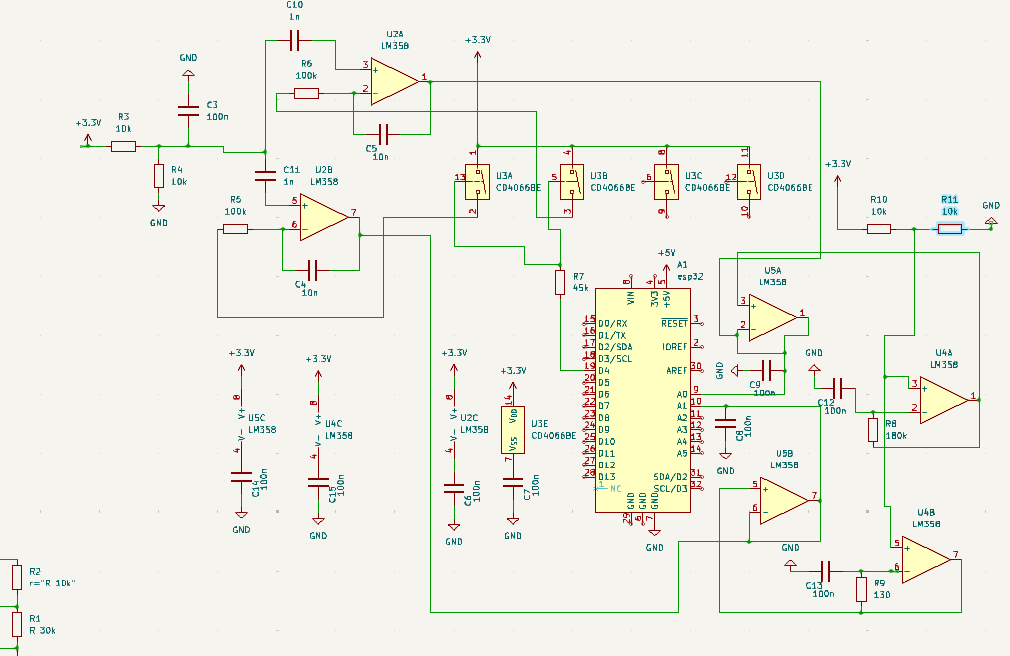
2 Analog Conditioning & Frequency Shaping (LM358)
For the implementation of the hybrid analog–digital computing system, the LM358 operational amplifier was selected due to its compatibility with low-voltage single-supply operation (3.3–5 V) and its predictable behavior under saturation conditions.
The LM358 can accept inputs referenced to ground and maintains stable operation when signals are centered around a virtual ground (Vref), a characteristic exploited in the present design.
In the proposed system, information is not encoded in the precise voltage amplitude, but rather in the timing and frequency of pulses. For this reason, the limited output swing of the LM358 near the supply rails is not a disadvantage; instead, it is used functionally to generate thresholds and timing transitions.
Although the LM358 has a relatively limited bandwidth and slew rate, it is sufficient for the operating frequencies of the system (a few kHz to tens of kHz) and provides stable and repeatable behavior.
Therefore, the LM358 represents a technically justified solution for experimental and hybrid AI systems, where priority is given to simplicity, low power consumption, and temporal signal processing, rather than high analog precision.
The LM358 stages are used for:
- High-frequency filtering
- Pulse stabilization
- Controlled timing response
Resistors R5 and R6 (100 kΩ) combined with capacitors C10 and C11 (1 nF) create controlled time constants, which:
- limit high-frequency noise
- preserve the essential frequency information
This stage is not intended for precise analog amplification but rather for temporal stability of pulses, which is critical for frequency-based computation.
As a new WordPress user, you should go to your dashboard to delete this page and create new pages for your content. Have fun!